Victory Mansions
Victory Mansions is the decaying block of flats in London, chief city of Airstrip One, where Winston Smith lives while working at the Ministry of Truth. It is the novel's first setting and the place where its decisive private act takes place: in a blind spot of the telescreen, Winston opens the diary that makes him a thought-criminal. The block is also the most local proof of the Party's failure, a place where lifts do not run, flats smell of boiled cabbage, and posters of Big Brother follow every movement.
A Decaying Block
On a bright cold day in April, with the clocks striking thirteen, Winston slipped through the glass doors of Victory Mansions, "though not quickly enough to prevent a swirl of gritty dust from entering along with him." The hallway smelt of boiled cabbage and old rag mats, and at one end a coloured poster, too large for indoor display, showed an enormous face—a man of about forty-five with a heavy black moustache—beneath the caption BIG BROTHER IS WATCHING YOU. The lift was no use: even at the best of times it was seldom working, and at present the electric current was cut off during daylight hours as part of the economy drive in preparation for Hate Week. Winston, thirty-nine and with a varicose ulcer above his right ankle, went slowly up the seven flights, resting several times, while on each landing the same poster gazed from the wall.
The building itself was old—built, it was said, in 1930 or thereabouts—and falling to pieces. Plaster flaked constantly from ceilings and walls, pipes burst in every hard frost, the roof leaked whenever there was snow, and the heating system was usually running at half steam when it was not closed down altogether from motives of economy. Repairs, except what one could do for oneself, had to be sanctioned by remote committees which were liable to hold up even the mending of a window-pane for two years. Mrs Parsons, the wife of a neighbour on the same floor, was always calling Winston across for such amateur repairs: her kitchen sink stood full of filthy greenish water that smelt of cabbage, and Winston, who hated using his hands and hated bending down, knelt and removed the clot of human hair that had blocked the pipe.
A Home That Cannot Be Shut Off
In Winston's own flat the telescreen, an oblong metal plaque like a dulled mirror, could be dimmed but never shut off; it received and transmitted simultaneously, so that any sound above a very low whisper could be picked up and any movement within its field of vision could be seen. One had to live in the assumption that every sound was overheard and, except in darkness, every movement scrutinised. The poverty of the place was equally inescapable: in the tiny kitchen there was only a hunk of dark-coloured bread that had to be saved for tomorrow's breakfast and a bottle of Victory Gin that tasted like nitric acid, while Victory Cigarettes lost their tobacco if held upright. Winston kept his back to the screen when he could, knowing that even a back can be revealing.
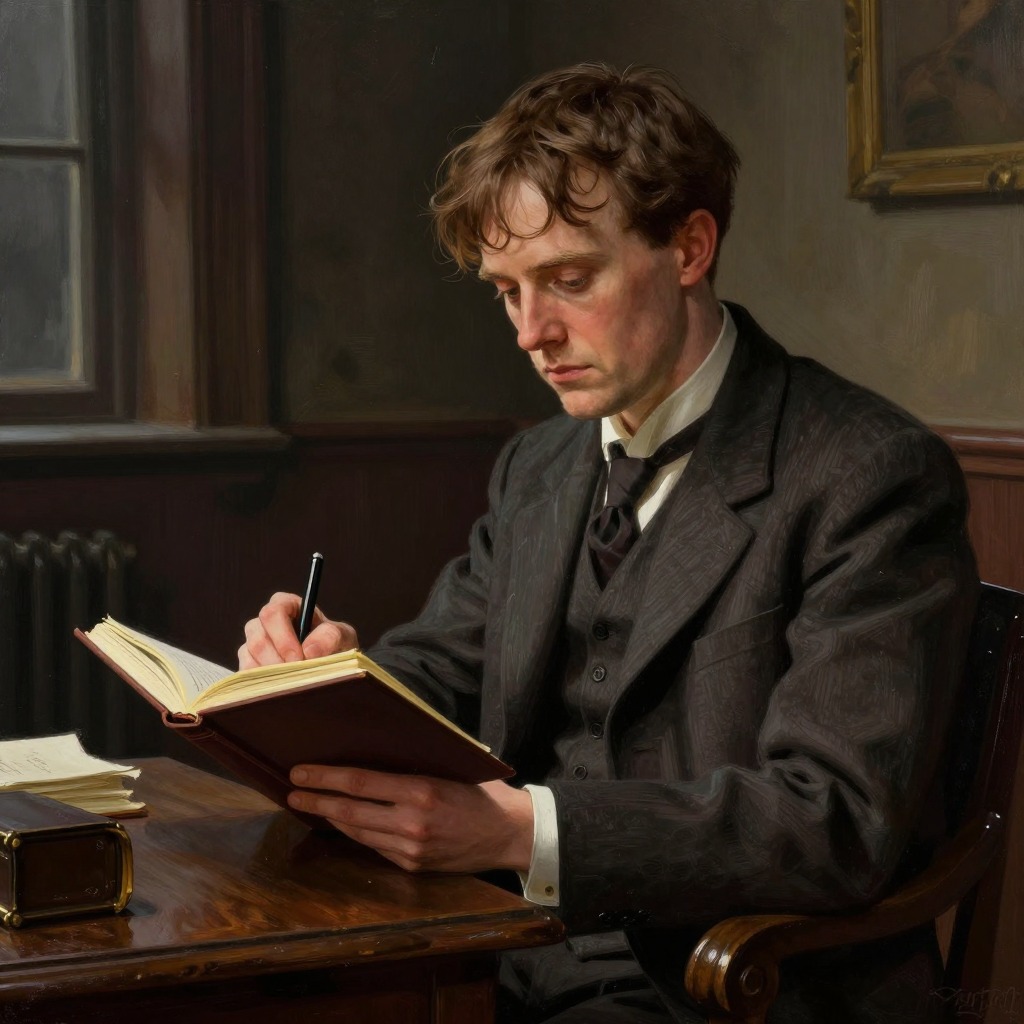
The living room's unusual geography gave him his only advantage. Instead of being placed in the end wall, where it could command the whole room, the telescreen was in the longer wall opposite the window, and beside it was a shallow alcove, probably intended for bookshelves, where Winston could sit well back, outside the range of the screen's sight. This partly suggested the thing he was about to do. He had bought a beautiful blank book—a quarto-sized volume with a smooth creamy paper, a red back and a marbled cover—for two dollars fifty from a junk shop, and had carried it home guiltily in his briefcase; even with nothing written in it, it was a compromising possession. In the alcove he fitted a nib into an archaic pen and wrote "April 4th, 1984."; then, in a sudden panic, he filled half a page with DOWN WITH BIG BROTHER. Later he laid an identifiable grain of whitish dust on the corner of the cover, where it would be shaken off if the book was moved—a precaution which, years afterwards, he learned had been observed and carefully reproduced by the Thought Police, who had watched him for seven years.
Tenants, Children and Hate Week
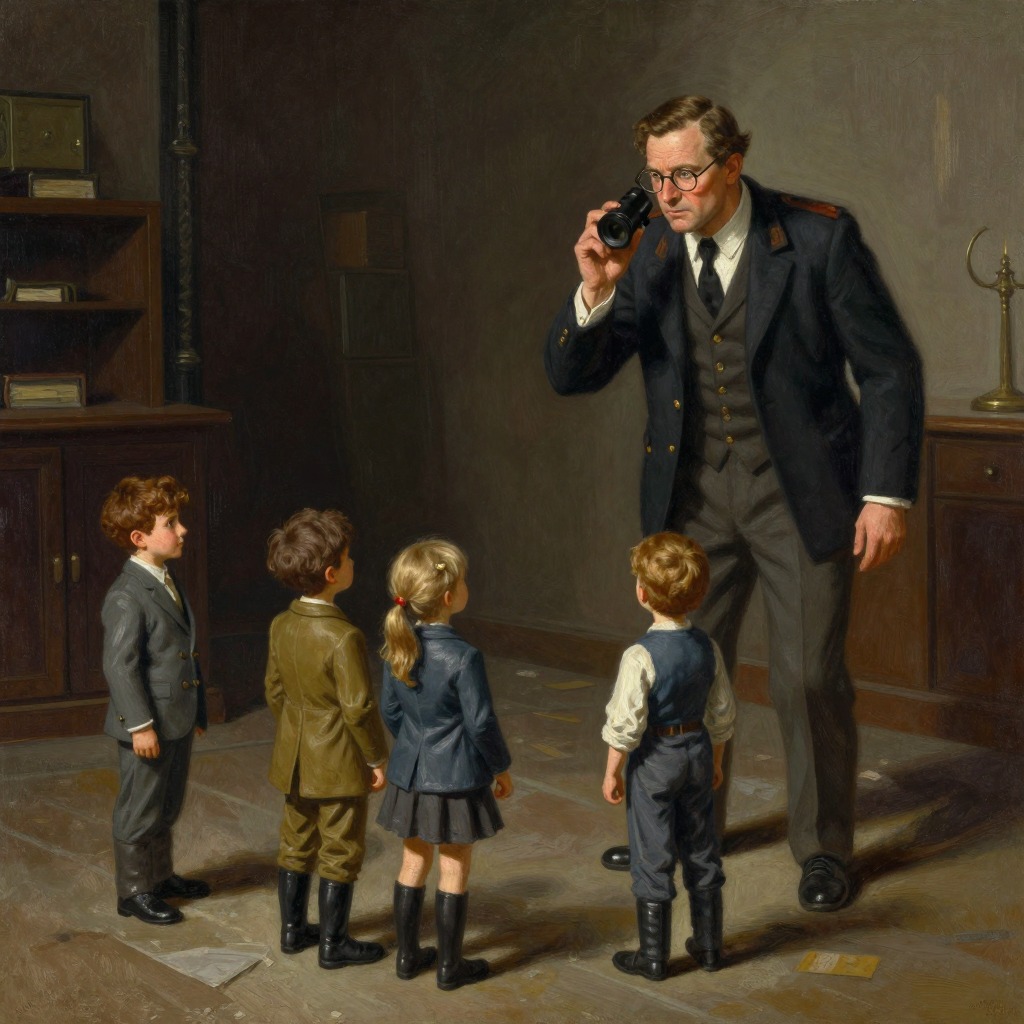
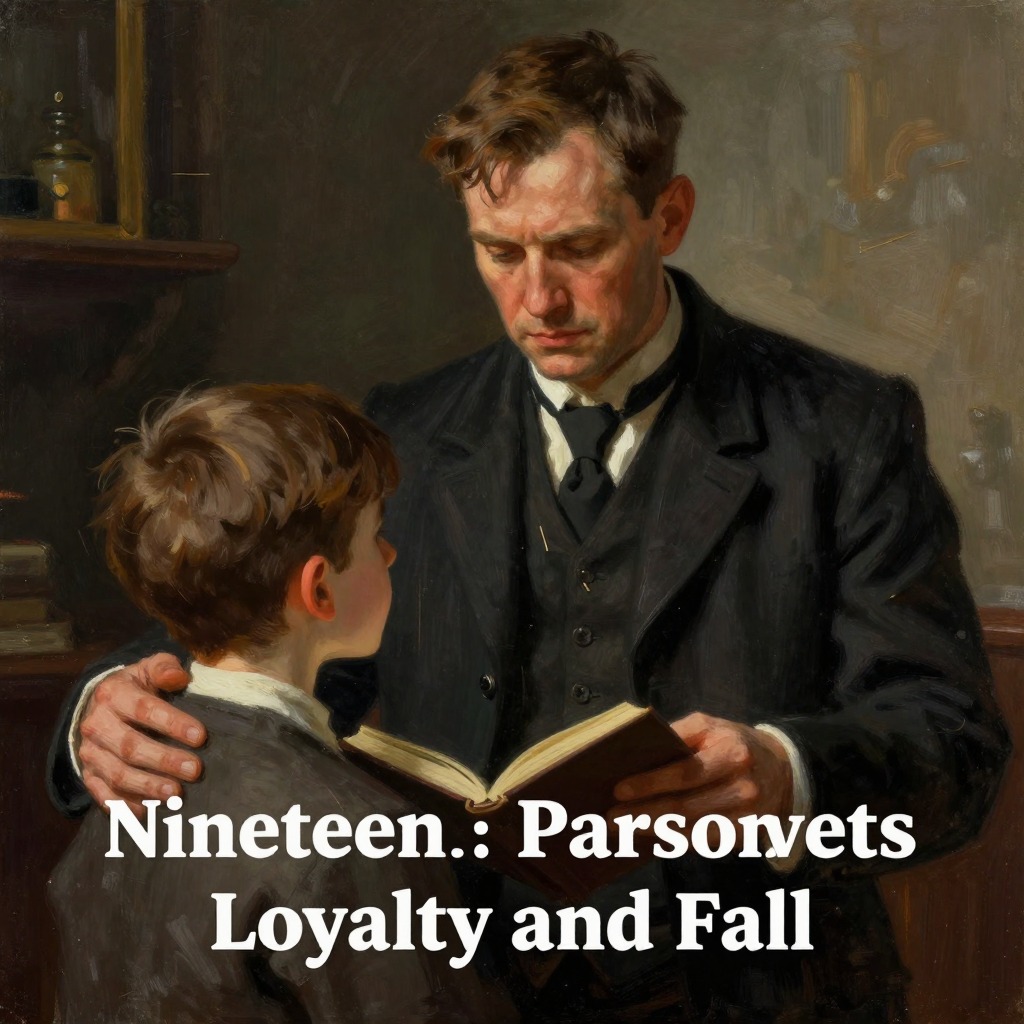
Victory Mansions was also a small society of tenants. On the same floor lived Mrs Parsons, a colourless, crushed-looking woman of about thirty who looked far older, with dust in the creases of her face, and her husband Tom Parsons, Winston's colleague at the Ministry of Truth—a fattish, active man of paralysing stupidity and imbecile enthusiasms, a devoted drudge on whom, more even than on the Thought Police, the stability of the Party depended. Their flat was bigger than Winston's and dingier, littered with hockey sticks, boxing gloves, a burst football and sweaty shorts, hung with scarlet banners of the Youth League and the Spies and a full-sized poster of Big Brother. Their children, a tough-looking boy of nine and his sister about two years younger, both in the blue shorts, grey shirts and red neckerchiefs of the Spies, sprang out at Winston shouting "Traitor!" and "Thought-criminal!" and menaced him with a toy pistol; later the boy hit the back of his neck with a catapult. Mrs Parsons explained that they were disappointed because they could not go to see the hanging in the Park that evening.
Winston read the children as the Party's deliberate product. By means of organisations like the Spies they were systematically turned into "ungovernable little savages" who nevertheless adored the Party, their ferocity directed outward against traitors, saboteurs and thought-criminals; it was almost normal for people over thirty to be frightened of their own children, and hardly a week passed without the Times printing a paragraph about some eavesdropping "child hero" who had denounced a parent. Mrs Parsons's helpless terror made the block feel like a nest of future informers. Yet the same building was the focus of communal loyalty. Parsons, as block treasurer for the Hate Week house-by-house fund, collected Winston's promised two dollars and promised an all-out effort to give Victory Mansions the biggest outfit of flags in the street; in the weeks before Hate Week he organised squads of volunteers who stitched banners, painted posters, erected flagstaffs and slung wires across the road for streamers, while boasting that Victory Mansions alone would display four hundred metres of bunting. The economy drive that kept the lift out of action was the same preparation that made the building blaze with loyalty.
Narrative Significance
From Victory Mansions the apparatus of Oceania was visible in both directions. From Winston's window the Ministry of Truth towered a kilometre away, an enormous pyramidal structure of glittering white concrete three hundred metres high; from the roof one could see all four Ministries at once, so completely did they dwarf the surrounding architecture. The block thus stands where private life and public spectacle meet: inside it the Party's slogans are on every wall and its telescreen watches the living room, while the building's broken fabric keeps exposing the gap between promise and reality. The novel begins with Winston passing through its doors to open a diary in the telescreen's blind spot, and the only true privacy the building offers is accidental—and, as the seven years of surveillance finally reveal, illusory.